
 Challenge was established in 2010, towards the end of the international process that designed the KUMI method, to reduce the levels of violence in the land using the Conflict Transformation approach that is central to the KUMI methodology. Challenge founders were members of the team that designed KUMI
What is KUMI?
KUMI is a values-based, action-oriented method for social transformation in conflict. Integrating terms and concepts from philosophy, psychology, peace studies and political economy, KUMI can
be defined as a method for making change happen in accordance with the collective will of a group.
The desired change relies on movement on a number of interconnected levels:
● forming of a new understanding of the reality of the conflict
● developing a new awareness of self and others
● adopting new behaviours to reflect the enhanced understanding and awareness
The overall intention is that these changes will transform, through word and deed, the structures (i.e. ideologies, institutions, policies, programmes, operative orders, administrative regulations, etc.) that are generating conflict and turn them into structures for attaining and sustaining equitable development and just peace.
The KUMI Process
This method adopts and modifies three core tools:
1. The Participatory Strategic Planning (PSP) process developed by the Institute of Cultural Affairs
2. ARIA, developed by Jay Rothman to engage primarily with identity-based conflicts
3. TRANSCEND, an integrative analytical approach to conflict engagement based on the work of Johan Galtung.
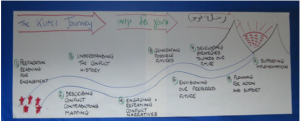
KUMI consists of five phases, each designed to build on the one before it. Each phase is followed by a “doorway” to ensure that everyone involved is ready to move on. If not, then more time will need to be spent at the previous phase. In addition, the exact order of the phases may vary depending on the needs of each particular group.
The five phases are:
1) Initial Contact, Exploration and Project Design
2) Stage Setting, Group Building and Choosing the Contradictions
3) Deep Conflict Engagement
4) Participatory Strategic Planning
5) Supporting Implementation
Each phase, each session of the workshop, and the method as a whole, is designed to achieve two types of objectives:
● A rational objective, which refers to the resolve of the group and its evolution towards acollective decision to act in order to change the status-quo
● An experiential objective, which refers to the cognitive and emotional change on the level of individual participants and the evolution of their identification of one another and their
cohesion as a group.